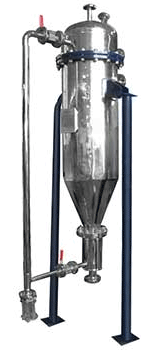

Metal catalyst recovery
A catalyst is needed in many chemical reaction without being consumed by it.
Strong Acid Cation (SAC) Resins provide strong acid sites on H+ form (solid acid catalyst) and can replace liquid acid catalyst in many catalysis applications. Resins show similar catalytic activity to sulfuric acid, with the advantages of easier separation of products, less by-product reactions, less corrosion to equipment, less environmental pollution, energy saving, and continuous production.
The main properties required for catalytic resins are their capability to work at high temperature (130°C to 170°C), and their high acid capacity. Other parameters are also important for the best selection of resin for higher activity: their particle size, surface area and pore diameter.
The main catalyst reaction using solid acid catalyst are:
- The etherification (Olefin + alcohol -> Ether) producing MTBE, ETBE and TAME
- The esterification (organic acid + alcohol -> Ester) producing the dimethyl maleate
- The condensation (phenol + acetone -> Bisphenol A + Water)
- The hydration (olefin + water -> alcohol) producing Isopropyl alcohol (IPA),..
- The hydrogenation (acetone + H2 -> MIBK + water)
- The aromatic alkylation (olefine+phenol->alkylphenol) producing octyl phenol, …
Some of these reaction will need DRY catalyst, for higher activity or non-aqueous chemistry such as phenol aklylation, and the SAC resin is supplied on wet or Dry form, depending the application.