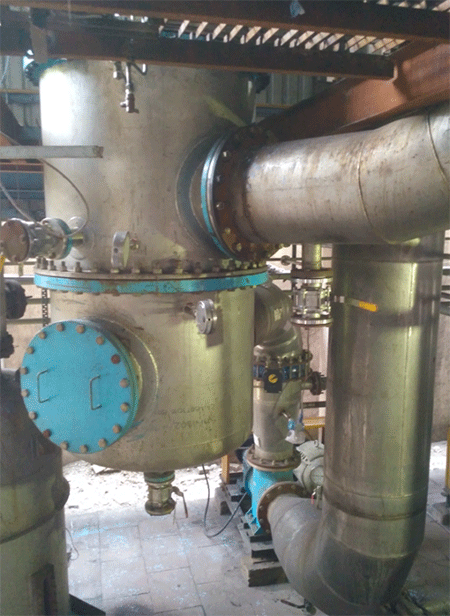

Self-cleaning Fluidized Bed Heat Exchanger
For shell and tube heat exchangers that experience fouling an alternative to cleaning and redundancy can be to equip the heat exchanger with a self–cleaning system based on fluidized bed technology.
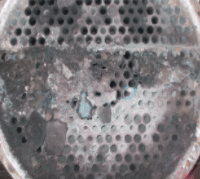
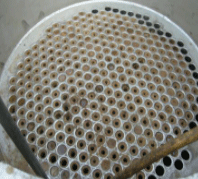
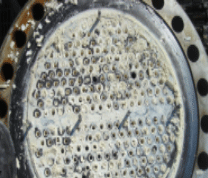
With the self–cleaning fluidized bed heat exchanger, developed to operate up to zero–fouling, any type of fouling deposits can be effectively handled, whether hard or soft, originating from biological, crystallization, chemical or particulate fouling mechanism, or a combination of these. It can be applied for a wide variety of fluids ranging from aqueous solutions, to oils and slurries.
The operating principle of the self–cleaning fluidized bed heat exchanger is based on the circulation of cleaning particles through the tubes of a vertical shell and tube heat exchanger. The particles are fluidized by the upward flow of the liquid, where they create the mild scouring effect on the wall of the heat exchanger tubes, thereby removing any deposit at an early stage of fouling formation. After the tube bundle the particles disengage from the liquid in the separator and are returned to the inlet channel through an external downcomer, and the cycle is repeated. Depending on the type of liquid a sieve, cyclone or gravity separator is used.
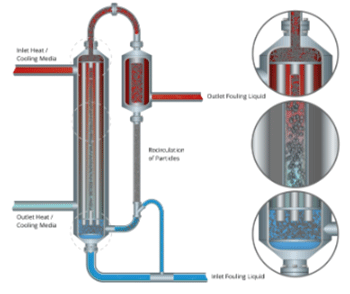
Random movement of particles gives:
- an impact with tube wall, removing the fouling layer
- a break–up of the boundary layer, increasing heat transfer
- a shear thinning effect, reducing the viscosity