

Diafiltration
Diafiltration is a process for separation and purification of the target product out of the main solution containing the other small molecular weight (MW) substances, e.g. salts, solvent. The term ‘diafiltration’ means a combination of ‘dilution’ and ‘filtration’. A buffer solution or demineralized water is added into the concentrate or retentate to make up the lost permeate water during filtration, in such a way keeping the concentration of rejected compounds (i.e. target products) constant, while diluting the unwanted small MW compounds for their gradual ‘washing out’ through filtration cycles.
Diafiltration is widely used in the areas of:
- Biotech & pharmaceutical, for e.g. enzyme/antibiotics/serum/polypeptide extraction and purification;
- Food & beverage, e.g. sugar separation, dealcoholization;
- Dairy industry, e.g. whey protein isolation, lactose demineralization;
- Resource recovery, e.g. organic matter extraction from surface water.
Diafiltration is normally performed with one batch of feed water, the retentate recycles back to the feed tank for further processing, and buffer solution or demineralized water is added in the feed tank as diluent. The way of adding the diluent can be continuous or discontinuous. Continuous diafiltration has advantage of maintaining a stable concentration of target product in the retentate, which is viewed as a more gentle process, especially for biomolecule product, as varying concentrations might incur molecular interactions and cause product loss consequently. In this continuous diafiltration mode, diluent is added with the same flowrate of permeate, when the produced permeate volume reaches to the same as the initial feed volume, 1 diafiltration volume or 1 diafiltration cycle is processed.
The extent to which target product is purified depends on the diafiltration cycles, and the permeability of the unwanted species. The more permeable the unwanted species, the less diafiltration cycles are required. For example, for ions with 100% permeability (e.g. to an ultrafiltration membrane), 7 diafiltration cycles are sufficient to have nearly 100% ion removal from the feed solution. Whereas 9 cycles are required to fully remove species with 75% permeability on the same ultrafiltration membrane (Source: Diafiltration: A fast, efficient method for desalting, or buffer exchange of biological samples, by Pall Life Sciences, PN 33289).
In addition, the selection of membrane with a proper molecular weight cutoff (MWCO) is important. The MWCO of a membrane is regarded as the molecular weight (MW) of a specific polymeric compound which has 90% rejection on this membrane. It means there is possibility of the target product passing through the membrane if the MWCO of membrane is exactly the same as the MW of the target product, especially during diafiltration, with a ‘washing out’ effect there will be more product loss. Therefore, a tighter membrane in relative to the MW of the target product is advised.
The process diagram of diafiltration is presented in Figure 1, in which an internal recirculation pump helps to provide a crossflow along the membrane surface (also termed as ‘tangential flow’), reducing the membrane fouling potential
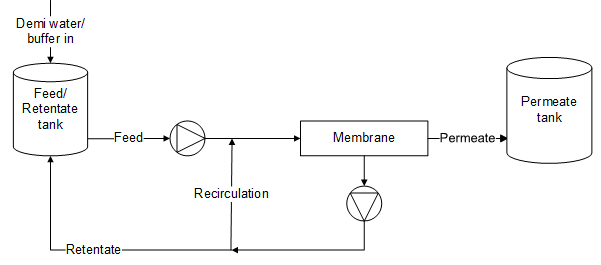
Figure 1 – Process schematic diagram of diafiltration with internal recirculation
In Lenntech, we help our clients to test their feed solutions with our lab- and pilot- installations, in such a way to select the best membrane for their specific product, and also to optimize the diafiltration process with respect to e.g. feed pressure, initial diafiltration concentration, crossflow rate, for a high product yield in a less processing time. Based on the test results, we move forwards to design, engineer, manufacture a pilot-scale or full-scale diafiltration system for our clients.
For more information or quotation, please contact us:  Feedback Form or call us on +31 152 610 900